


A Seat at the Table: Black Women, HIV, and the Fight for Health Equity
By Ryann Flynn
Malcolm X proclaimed, “The most disrespected person in America is the Black woman. The most unprotected person in America is the Black woman. The most neglected person in America is the Black woman.” Black women in America are in a constant battle with societal pressures and wellbeing. Black women are often the protectors, the teachers, and the providers, yet with all that care being poured into others, Black women’s cups are still empty. This systemic struggle is encapsulated by misogynoir, a term coined by Black, queer author Moya Bailey. Misogynoir is the intersectional term that combines misogyny and anti-Blackness. As Moya Bailey explains, “What happens to Black women in a public space isn’t about them being any woman of color. It is particular and has to do with the ways that anti-Blackness and misogyny combine to malign Black women in our world.”
How does this reality align with the daily barriers Black women face in their health? For every disparity that we top the charts on, it circles back to being underrepresented and overlooked by society. A mentor of mine, Ebony Gordon, founder and facilitator of HUES (Healin’ and Uniting Every Sista), captured this intersectionality perfectly when she said, “When it comes to HIV, regardless of what your educational background is, your socioeconomic status, if you’re a Black woman or born as a Black girl in this country, it just puts you at a disadvantage for any health condition, including HIV.” When it comes to heart disease, diabetes, high blood pressure, high mortality rates among Black birthgivers, and high rates of new HIV diagnoses, Black women are tragically at the top of the charts. Though we make up only 12.8% of the female population, in 2023 AIDS Vu found that Black women make up 49.3% of new HIV diagnoses.
This is a dark statistic, but what are the contributing factors? For one, racism plays a huge part in these statistics, but another issue is that Black women are not having conversations about sexual health enough. There is still a lot of social taboo that goes with sexuality and Blackness, yet it’s one that we are surely overcoming. The HIV transmission rates, however, are slow in recognizing this evolution. If you look back at the HIV data collected from 2022-2024, you’ll notice the steady trend in the data is the fact that Black women are at the top of HIV transmission rates. This data is enough to fuel Black women in the HIV field to make strides to alleviate that disparity and create an open dialogue with Black women about their sexual health.
Insights from the USCHA Conference
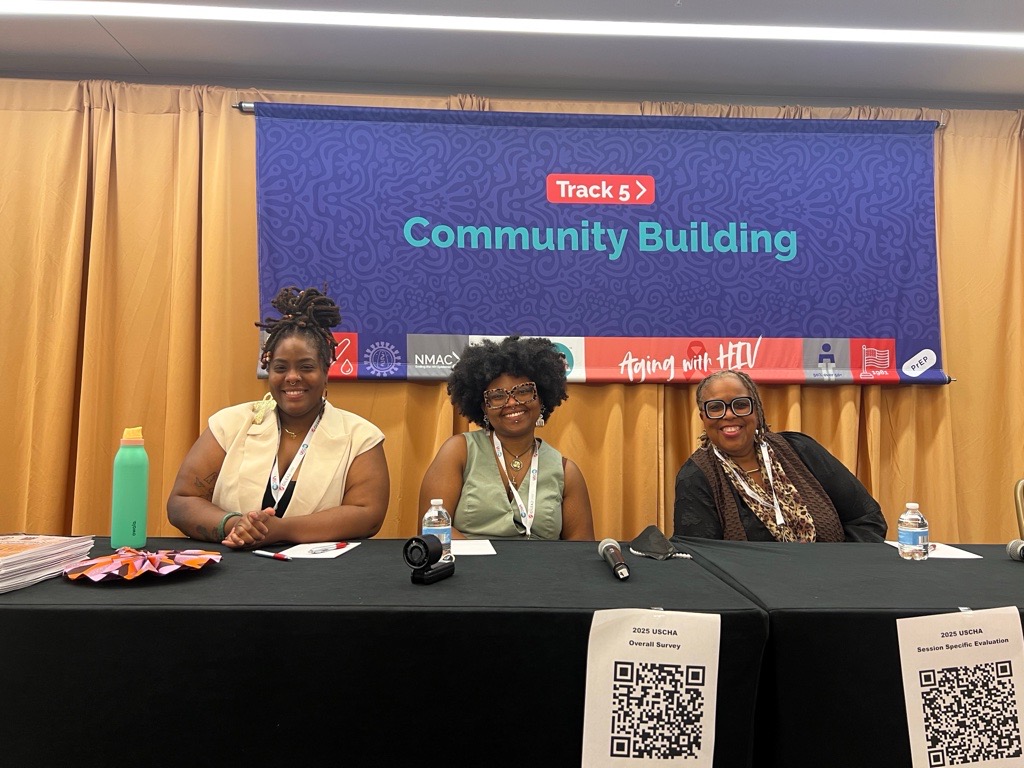
In September, I had the amazing opportunity of attending the US Conference of HIV/AIDS (USCHA) in Washington D.C. that centered its theme on honoring those Aging with HIV and long-term survivors. There I focused my workshop experience on intergenerational Black women living with or at risk for HIV. Black women and PrEP, Black women Aging with HIV, and Black women sharing their legacy were the workshops that contributed to my knowledge gain from the USCHA Conference. I was even allowed to assist with a workshop myself. The workshops encountered brought me a radicalized knowledge to fuel me into focusing my work on the support of Black women.
In each of these workshops, everyone in the room who identified as a Black woman, regardless of age, realized: we are ignored. Plain and simple. Still Here, Still Powerful: Black Women, HIV & Aging with Grace and Grit was a workshop that had a lasting impact on my path. Here were these three beautiful, intelligent Black women, aging with HIV and talking about the vulnerability of losing social capital in the eyes of society. Here were these women, elders, showing us that aging with HIV isn’t something to fear; it’s a journey to nurture, to understand. Now that folks who were diagnosed in the 80s, 90s, and 00s are aging, the medical world has a lot of new territory to explore in response. These women talked about noticing their social capital as Black women aging with HIV start to dwindle and having to create that network of support with other Black women. This workshop was to shed light on the rhetoric that people most at risk aren’t just white, gay, cis-males, its Black women, intergenerationally. Yet, research does not mirror demographics within the data.
When it comes to prevention, Pre-exposure prophylaxis (PrEP) is an effective oral daily medication that reduces the risk of HIV through sex by 99% when taken as prescribed. This is a great way for Black women to protect themselves, however, less than 2% of eligible Black cisgender women take PrEP. We make up even less when it comes to research done about Black women and PrEP. Another workshop I attended focused on trying to get Black women on PrEP even though the research about this transformative prevention doesn’t focus on Black women at all.
Here you have this pill that is known to be extremely effective medically and cost-wise, then the statistics of Black women getting HIV at alarming rates, yet the two don’t seem to correlate. This workshop was brainstorming ways that Black women in the HIV field are trying to get more Black women to take advantage of a pill that could make a huge impact on HIV transmission rates if there is enough effort put into the approach.
Sankofa Rising, a workshop created by Ebony Gordon of the San Francisco AIDS Foundation (SFAF), was created to honor the women living with HIV, not by focusing primarily on their diagnoses, but by focusing on the person in front of the disease who’s thriving despite it. A common theme in these Black women-centered workshops was continuing to share stories, because, if not us, then who? Sankofa Rising let Black women know that they are more than their diagnosis and instead are the stories that came before and after it. Continuing the storytelling as a way to keep Black women alive, this workshop was a conversation designed to bring together a sisterhood of those living with HIV and those at risk.
The workshops stepped away from traditional lecture and panel formats and instead made it interactive to truly engage Black women in the conversation about their sexual health. I was able to see what a safe space for sexuality looked like among Black women. Education was spread throughout the room; connections were made through relatable experiences, and a communion was experienced that spanned a special three hours. These were my experiences at the USCHA Conference in Washington, D.C. and it brought me back to the Bay with a renewed perspective on how to support Black women to continue having or starting HIV care and how to help Black women with HIV protect themselves from transmission.
Rafiki Coalition and Their Legacy
Working at Rafiki Coalition, I quickly became accustomed to the legacy Rafiki possesses. Rafiki has been the pillar of the community since 1986, when they were known as the Black Coalition on AIDS (BCA). They saw the need to make space during the AIDS epidemic for Black people who were ignored. During the height of the epidemic, the disease was presented to the masses as a gay cis male disease. This silenced communities in ways that were detrimental to their livelihood. That’s where BCA made space for those previously silenced to be heard.
Their response to the AIDS epidemic was to tailor programs within the organization to the many identities that come with being Black. In 1994, they started Youth Services, in 1998, they created Transgender Services, and they created a program for Black men living with or affected by HIV called Brothas Alive! BCA’s tailored response brought unity to those who would have been isolated or discarded by a debilitating epidemic.
Flash forward to now, 40 years into the legacy, and Rafiki Coalition is still making room for HIV support with their programs. For one, Brandy Moore House provides transitional housing that gives folks living with HIV or recovering from substance use a safe space to improve their lives. This transitional program has impacted so many lives and provided an enlightened path with support.
Another Rafiki program that is making space for Black people at risk or living with HIV is the Umoja Health Access Point (Umoja HAP). This program takes a clinical approach to the health disparities faced by Black folks by giving us a centralized location to provide services that directly combat these health disparities. Umoja HAP was created with one main goal in mind: to help lower the health disparities faced by Black and other marginalized communities. Umoja HAP tackles these disparities by providing services that directly impact the statistics. As Umoja HAP continues to expand, so will the services provided, but the HAP’s fleet of services is making the impact needed.
The San Francisco AIDS Foundation, Black Health department has three support groups that make up its programming: Black Brothers Esteem, a support group designed for Black, gay men living with or at risk for HIV; TransLife, a program that is designed for folks who identify as Trans or gender non-conforming; and HUES (Healing and Uniting Every Sista), the first group in SFAF history to be created for Black women living with or at risk for HIV. These programs have made significant strides in supporting the Black HIV community with groups that bring them together in community, ridding the participants of social isolation and tending to their mental wellbeing.
A Seat at the Red Table: World AIDS Day Event
The San Francisco AIDS Foundation and Umoja HAP are hosting a World AIDS Day event that is meant to be a conversation. A Seat at the Red Table is an event that gives Black folks living with or at risk for HIV a chance to find community and safety in discussing what is plaguing our communities today.
Umoja Health Access Point is a San Francisco Department of Public Health (SFDPH) program that aligns with other health access points in the SF area. It is designed to target disparities faced by marginalized communities, and Umoja HAP was created to tackle the obstacles faced primarily by Black communities. Umoja HAP achieves results by directly combating issues with solutions. For example, our answer to the food desert in Bayview was our partnership with the San Francisco-Marin Food Bank, and our answer to mental health issues was to provide mental health services through Glide, and the list goes on. Regarding HIV support, we provide numerous resources to alleviate all the societal issues related to HIV. We provide testing with the assistance of UCSF: Alliance Health Project, and we’re continuing our HIV support by providing a way to connect with community.
A Seat at the Red Table is unlike the usual World AIDS Day events. Normally, you’ll see panels with experts in the HIV field, and while educational, Ebony Gordon, the founder and Program Specialist for HUES, wanted this event to be different and be a conversation. “It’s meant to flow. I think that after we get past the dinner eating portion, the real meat comes in when we get to our fireside chat portion of the flow. We’ll have these circle keepers. And the circle keepers are not facilitators. They’re not hosts or MCs. They’re meant to model what vulnerability and sharing your story is, to inspire other people to also speak of and speak about the things that they’re dealing with and the perceptions that they have about HIV, sexual health, et cetera. It’s meant to be an organic, free-flowing conversation.”
Happening December 5th from 6-8 pm, A Seat at the Red Table is a chance for folks to come together and build community in a space where it’s safe to be vulnerable. With the HIV statistics for Black women being extremely alarming, we must start talking about what is affecting our community, and that means being open about sexual health and HIV. When we talk about these issues, we are saving the next person who is at risk by empowering them to choose protection and education when it comes to their sexual health. The Circle-Keepers will consist of people with real-life experiences that create an atmosphere of vulnerability, relatability, and safety.
Join us for A Seat at the Red Table this December 5th, for a community conversation centered on the experiences of Black community members across San Francisco. The event brings together those living with HIV, allies, advocates, and anyone committed to holistic Black wellness. The evening will feature a shared dinner, spoken word performances, and a guided fireside-style conversation centering on love, health, and healing in the era of HIV.
Take a Seat at the Red Table: Giving Tuesday and World AIDS Day
This year, Giving Tuesday and World AIDS Day come together in a powerful moment of reflection and action, and Rafiki Coalition invites you to take a seat at the RED table: a space of love, healing, and community.
For over 40 years, Rafiki has worked to eliminate health inequities by providing holistic care, advocacy, and wellness rooted in culture and community. We believe everyone deserves a seat at the table—a place where Black San Franciscans can be seen, heard, healed, and supported.
Why Your Donation Matters
Your donation helps us eliminate health inequities by expanding holistic care, HIV support, and culturally affirming wellness services for San Francisco’s Black and marginalized communities.
This Giving Tuesday, your gift helps us continue to:
- Build Spaces: Support facilities like our Umoja Health Access Point Clinic.
- Expand Programs: Grow vital mental wellness and health programs like Brandy Moore House.
- Honor Lives: Support and honor those living and thriving with HIV.
- Provide Care: Fund holistic health care, mental wellness support, and HIV prevention services for Black San Franciscans.
Together, we heal. Together, we rise.
Share
Subscribe to our free newsletter
Keep up to date with what's going on at Rafiki.
* Add notice about your Privacy Policy here.